URA’S NEW TAX COMPLIANCE STRATEGY: WHY BUSINESSES MUST START RECONCILING THEIR NUMBERS
For many businesses, tax compliance has traditionally been viewed rather narrowly: calculate the tax, file the return and make the payment before the deadline.
That approach is changing.
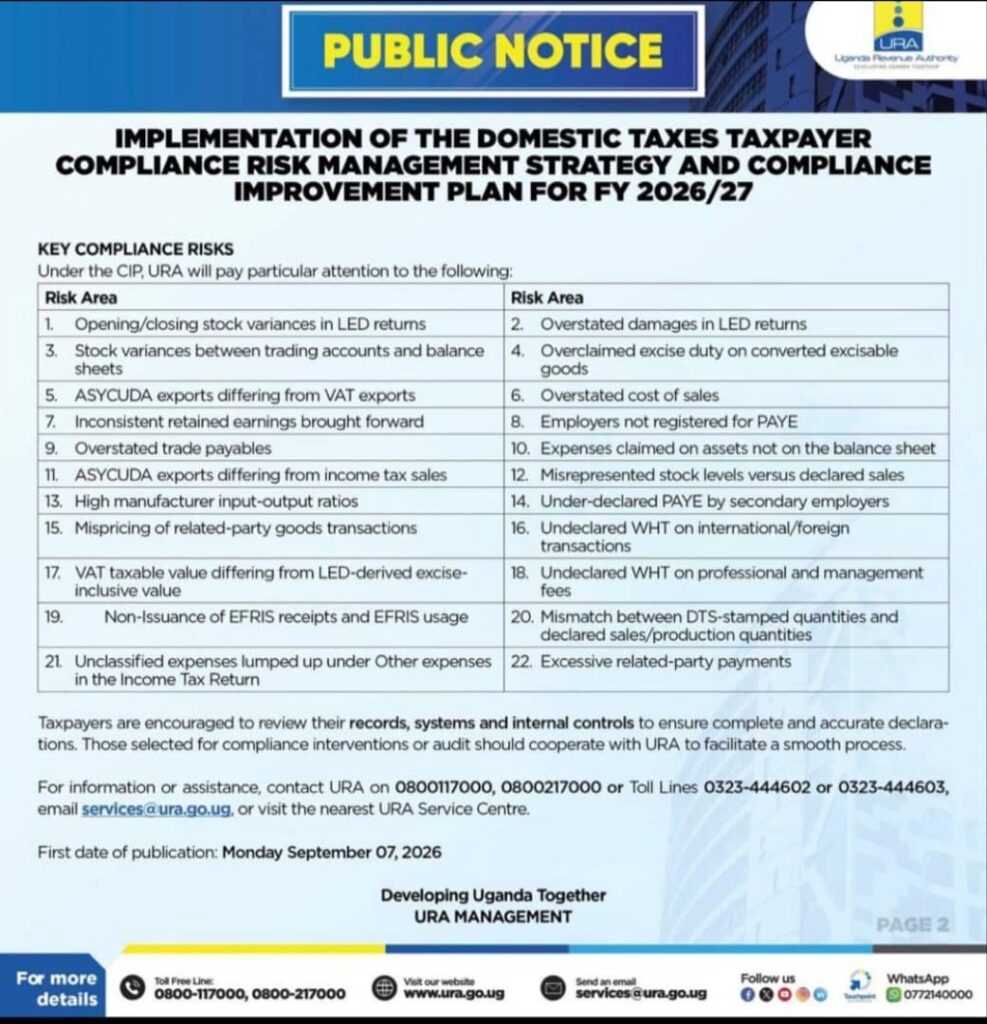
The Uganda Revenue Authority’s (URA) Domestic Taxes Taxpayer Compliance Risk Management Strategy and Compliance Improvement Plan for FY2026/27, published on September 7, 2026, identifies 22 specific compliance risks that will receive particular attention.
At first glance, these may appear to be technical issues for accountants and tax practitioners.
They are not.
They are business issues.
More importantly, they provide a window into the direction in which tax administration in Uganda is moving: towards a more data-driven, interconnected, and risk-based system of compliance.
The question is no longer: “Did you file?”
Consider a typical business.
It has sales records in its accounting system. It has invoices generated through Electronic Fiscal Receipting and Invoicing Solution (EFRIS). It has bank transactions, payroll records, and inventory records. If it imports or exports, it has customs information. If it manufactures, it has production records. Eventually, all these numbers find their way into tax returns.
That creates an important question: Do all these records tell the same story?
This is perhaps the most important message businesses should take from URA’s 22 identified risks.
Tax compliance is increasingly becoming a reconciliation exercise.
URA has specifically identified discrepancies between ASYCUDA exports and Value Added Tax (VAT) exports, Automated System for Customs Data (ASYCUDA) exports and Income Tax sales, stock and declared sales, and VAT taxable values and excise-related values.
For an importer or exporter, therefore, customs compliance can no longer be treated as something that ends at the border.
The customs declaration, accounting records and tax returns are connected.
A difference does not necessarily mean that a taxpayer has done something wrong. Businesses have genuine timing differences, returns, cancellations, foreign exchange effects, wastage and accounting adjustments.
But there is a difference between having a discrepancy and being unable to explain a discrepancy.
That distinction is becoming important.
Stock has become a tax issue
URA has also identified stock variances among the areas of risk, including differences between opening and closing stock in Local Excise Duty returns, trading accounts and balance sheets.
For manufacturers, the Authority has highlighted input-output ratios and differences between Digital Tax Stamp quantities and declared production or sales.
This means businesses need to understand the story behind their inventory.
If you purchased 1,000 units, produced 2,000, sold 2,500 and have 500 remaining, your records should be able to explain that movement.
It sounds basic. But sometimes, the basics are where the biggest tax problems begin.
“Other expenses” should not become a hiding place
Another area that businesses should examine carefully is expenditure.
URA has identified overstated cost of sales, overstated trade payables, expenses claimed on assets that do not appear on the balance sheet, inconsistent retained earnings, and unclassified expenses grouped under “Other Expenses”.
This should cause management to ask a simple question: If someone challenged this figure tomorrow, could we prove what it represents?
A large “Other Expenses” figure may be convenient for completing a return, but it does not tell the story of the business.
Good tax compliance starts with good financial information. And good financial information starts with proper classification, documentation, and internal controls.
PAYE and Withholding tax deserve more attention
The compliance strategy also points to Pay As You Earn (PAYE) risks involving employers who are not registered for PAYE and under-declared PAYE by secondary employers.
Withholding tax (WHT) is also highlighted, particularly on international transactions and professional and management fees. This is an important reminder for business owners.
The tax implication of a transaction should be considered before the payment is made, not after.
A payment to a consultant may be commercially legitimate.
A payment to a foreign service provider may be commercially necessary.
A management fee may be genuine.
But each transaction can still have tax consequences that should be considered.
Related-party transactions need scrutiny
For businesses operating within groups or dealing with related entities, URA has identified mispricing of related-party goods transactions and excessive related-party payments as compliance risks.
This brings transfer pricing firmly into the conversation.
Businesses should demonstrate the commercial rationale for related-party transactions, support the pricing and maintain appropriate documentation where the transfer pricing rules apply.
EFRIS is not just about issuing an invoice
There is another lesson here.
EFRIS should not be treated as a system that sits somewhere between the sales department and URA. It should form part of the business’s wider information system.
The EFRIS transaction should make sense when compared with the accounting records and tax returns.
The same principle applies to Digital Tax Stamps for affected businesses: production, inventory, stamped quantities, sales and tax declarations should be capable of being reconciled.
What should business owners do?
Stop waiting for the tax return to become your compliance review.
The review should happen before the return.
Management should periodically ask:
- Do our sales reconcile with VAT and Income Tax declarations?
- Does our inventory reconcile with our financial statements?
- Does payroll reconcile with PAYE?
- Do customs records reconcile with our tax records?
- Does EFRIS reconcile with our sales?
- Do production records reconcile with Digital Tax Stamp information?
- Are our expenses properly classified and supported?
- Can we substantiate our trade payables?
- Have we considered WHT on relevant payments?
- Are related-party transactions properly documented?
These questions are not merely for the accountant.
They are management questions.
URA’s strategy itself encourages taxpayers to review their records, systems and internal controls to ensure that declarations are complete and accurate.
No need for panic, but action
I would caution businesses against two extreme reactions.
The first is panic: assuming that every discrepancy automatically means an audit finding or tax violation.
It does not.
The second is complacency: assuming that because returns have always been filed on time, everything is fine.
That is equally dangerous.
The sensible response is somewhere in between:
Review. Reconcile. Explain. Document. Correct where necessary.
A legitimate difference is not necessarily a tax problem.
An unexplained difference, however, can become one.
URA’s 22 risks should, therefore, be treated as a business health-check list for FY2026/27, rather than simply another tax notice to file away.
Bigger picture
Uganda’s tax administration is becoming digital and interconnected.
As that happens, the ability to produce a tax return will become less important than the ability to demonstrate how the numbers in that return were arrived at.
That is where businesses need to rethink tax compliance.
Tax should not enter the conversation at the end of the month when a return is due.
It should be part of the way the business manages its sales, purchases, inventory, payroll, contracts, financing, related-party transactions, and cross-border activities.
Businesses that prepare before the questions come will always have a different experience from those that start looking for answers after the questions arrive.
The message from URA is clear: Don’t wait for the audit to discover your inconsistencies. Find them yourself.
Review your records. Reconcile your numbers. Document your position. And where something is wrong, deal with it early.
The writer is a tax expert at Demo Consult.